
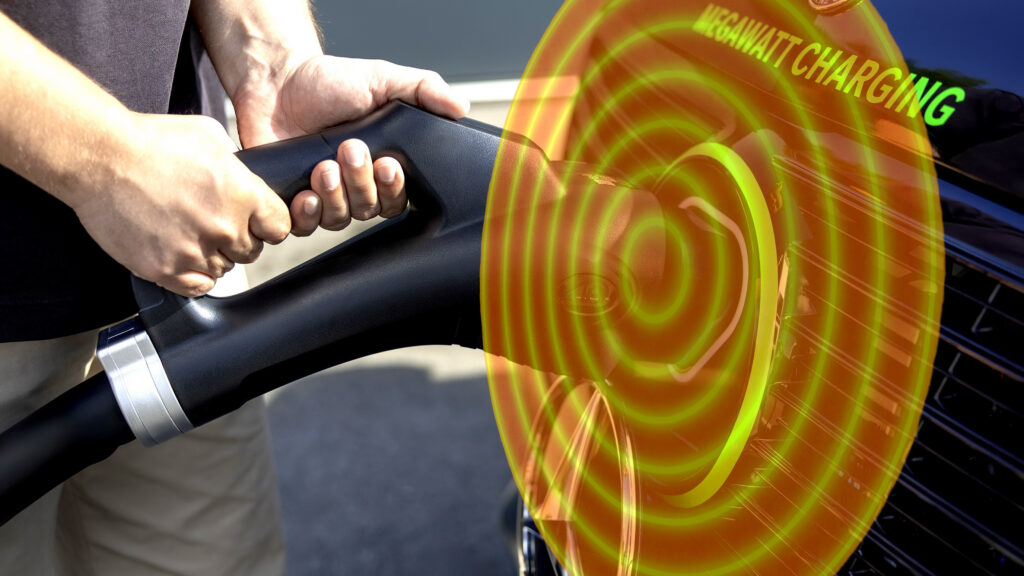

- A new study tested whether EVs expose drivers to hidden radiation.
- The German researchers tested 11 electric cars while driving and charging.
- Engineers used dummies packed with sensors to capture real conditions.
A new study has just delivered some reassuring news for anyone who has ever wondered whether sitting on top of a massive battery pack might quietly turn them into a human antenna. Electric cars, it turns out, aren’t the stealth radiation chambers some might imagine.
var adpushup = window.adpushup = window.adpushup || {que:[]};
adpushup.que.push(function() {
if (adpushup.config.platform !== “DESKTOP”){
adpushup.triggerAd(“0f7e3106-c4d6-4db4-8135-c508879a76f8”);
} else {
adpushup.triggerAd(“82503191-e1d1-435a-874f-9c78a2a54a2f”);
}
});
Germany’s ADAC auto club recently took a deep dive into electromagnetic fields in electric cars and found that drivers and passengers are exposed to very low levels of radiation.
Related: You Might Want To Keep Your Car Windows Closed While Charging
In fact, the results show that EVs are no more dangerous than any other modern vehicle and in some cases they actually give off less electromagnetic – or “electrosmog” – activity than cars with combustion engines.
var adpushup = window.adpushup = window.adpushup || {que:[]};
adpushup.que.push(function() {
if (adpushup.config.platform !== “DESKTOP”){
adpushup.triggerAd(“89c65a14-4682-4807-a4bb-5436c5361bee”);
} else{
adpushup.triggerAd(“f25825bd-1260-4574-84ce-2b26e315fad8”);
}
});
What Did They Test?

The study was commissioned by Germany’s Federal Office for Radiation Protection. It involved testing eleven electric cars along with a couple of hybrids and one conventional gasoline model.
Engineers from ADAC placed ten probes into a seat dummy and moved it through at least two seating positions while the vehicles were driven and charged. They wanted to know how strong the magnetic fields get under realistic conditions and whether any of them approach the thresholds that scientists consider risky.
During the on-road testing, the team observed a few brief spikes in magnetic field strength during hard acceleration and braking or when electrical components were activated. These peaks, though, are nothing unusual in a car that relies on high voltage circuitry and electric motors.
var adpushup = window.adpushup = window.adpushup || {que:[]};
adpushup.que.push(function() {
if (adpushup.config.platform !== “DESKTOP”){
adpushup.triggerAd(“bb7964e9-07de-4b06-a83e-ead35079d53c”);
} else {
adpushup.triggerAd(“9b1169d9-7a89-4971-a77f-1397f7588751”);
}
});
What the Numbers Show
According to ADAC, the electric fields and current densities that would actually arise in a human body under those conditions remained well below the recommended limits.
And the higher values were measured in the footwell, not near the head. In other words, there is nothing happening inside the cabin that would trouble your cells, your nerves, or your pacemaker.

One surprising finding came from a feature many of us use without a second thought. Heated seats produce some of the strongest electromagnetic readings, and this was true not only in electric cars but also in plug in hybrids and even the lone combustion model in the study.
var adpushup = window.adpushup = window.adpushup || {que:[]};
adpushup.que.push(function() {
if (adpushup.config.platform !== “DESKTOP”){
adpushup.triggerAd(“b25ecba7-3bbb-4ea7-a3a8-dbea91695c07”);
} else {
adpushup.triggerAd(“e46c436a-adeb-4b5e-a2c7-56bc36561c10”);
}
});
Even then, however, the numbers were far from dangerous. The most noticeable variations happened in the footwell near the electric drive units and their cabling while the head and torso area barely registered anything at all.
Does Charging Change Anything?
Charging did not make much difference either. AC charging created stronger readings around the plug at the moment the session began yet these levels also fell safely inside all guidelines. And despite its higher power output, DC fast charging produced weaker fields than the slower AC charging.

Sources: ADAC
#Drivers #Risk #Radiation #Study #Answers
